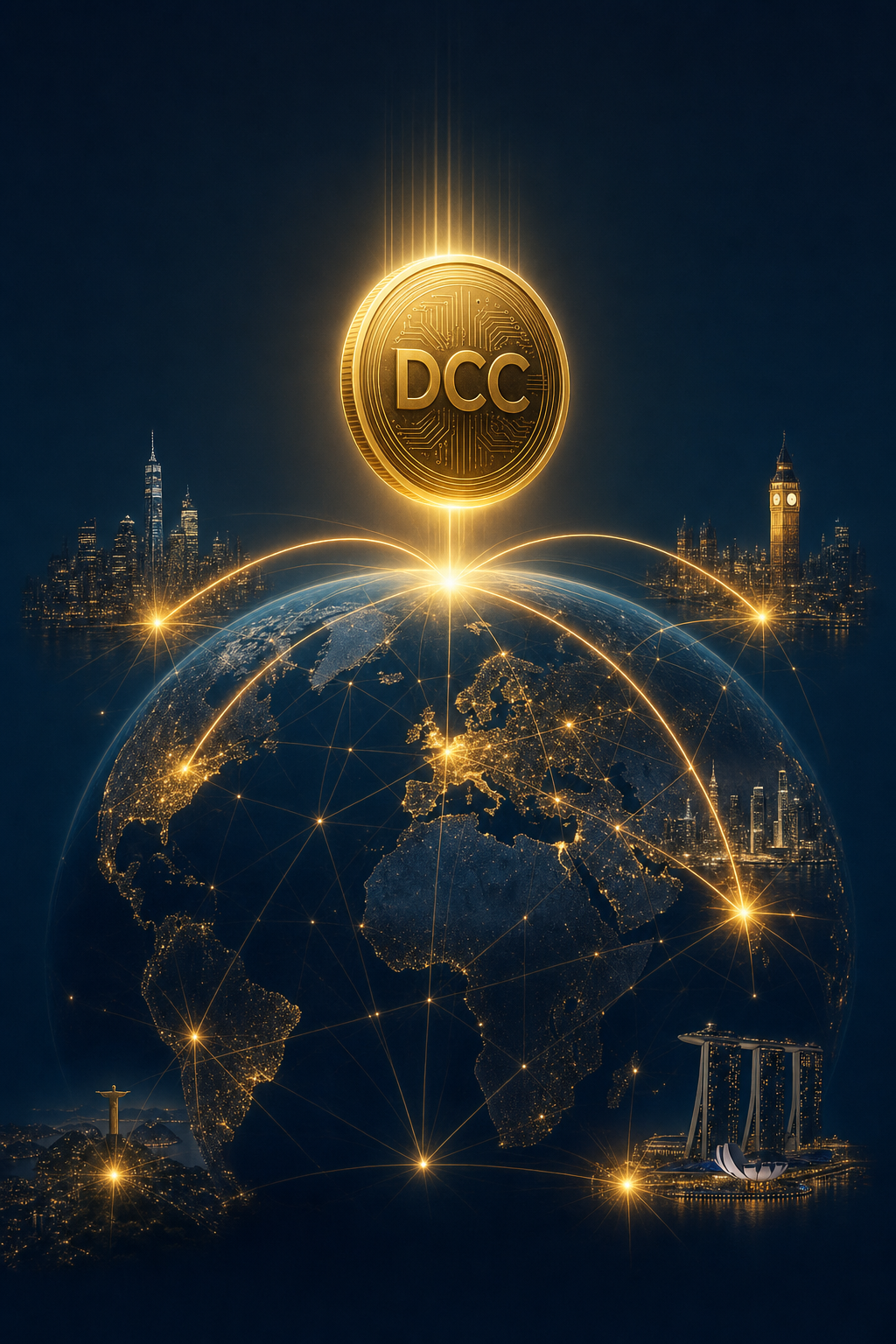
What DCC Actually Is (Plain English)
DCC is a utility token — meaning it has a specific job to do inside a platform, not just a price to go up and down. A utility token is like a membership key: it unlocks services, earns rewards, and grants access to things that regular crypto does not.
That platform is Deutsch Capital: a regulated bridge connecting crypto wealth to real-world assets, starting with prime Israeli real estate and expanding globally across markets, asset classes, and countries.
Think of DCC like this: every time money moves through the Deutsch Capital platform — a property purchase, a DC Pay merchant transaction, a currency conversion — a fee is generated. DCC holders capture a share of those fees. Not in printed tokens. In USDC — a dollar-backed stablecoin. Real money.
USDC (USD Coin) is a stablecoin — a digital currency pegged 1:1 to the US dollar. When we say yield is paid in USDC, we mean real, spendable dollars deposited directly to your wallet. Not DCC. Not some new token. Dollars.
The mechanics work through a smart contract called the FeeRouter. A smart contract is a piece of code that lives on the blockchain and executes automatically — no bank, no fund manager, no human in the middle. Every fee that enters the FeeRouter gets split and distributed on-chain, transparently, within seconds.
The fee split is on-chain and transparent: 40% operations, 25% liquidity, 20% ecosystem, 10% staking pool, 5% permanent burn. Every five percent that goes to "burn" means DCC tokens are destroyed forever — reducing total supply over time and making each remaining token marginally scarcer.
The Problems DCC Solves, One by One
Abstract concepts are easy. Let us be specific. Here are six real problems — and exactly how the Deutsch Capital platform solves each one.
Crypto is not accepted for real estate purchases. Developers and sellers want fiat — ILS, USD, EUR — not tokens they do not understand.
DC Pay converts any crypto to fiat (ILS, USD, EUR) via a licensed exchange within 48 hours. The developer receives fiat. The buyer completes a legally registered purchase. No one touches crypto they do not understand — and the transaction is 100% legal under Israeli real estate law.
Foreign buyers do not know how to navigate Israeli real estate law. The legal system is unfamiliar, contracts are in Hebrew, and the process is opaque.
DDG (Deutsch Development Group) handles everything end to end — KYC identity verification, attorney introduction, contract review, bank guarantee arrangement, construction monitoring, and delivery. Over 100 employees, 6 Israeli offices, 5 US representatives. 100% remote-capable. Available in English. You do not need to speak Hebrew or fly to Tel Aviv.
High-value buyers want real assets but face complexity. The gap between "I want to acquire real estate" and "I have title in my name" is filled with friction, uncertainty, and middlemen who do not talk to each other.
A full-service pipeline from first message to title deed. Reservation → due diligence → contract → staged payments via DC Pay → construction monitoring → delivery → property management. All coordinated by a single team. One point of contact. Globally accessible.
Staking rewards in most DeFi protocols are inflation in disguise. The project mints new tokens to pay you, which dilutes the value of everything everyone holds. You earn more tokens — but each token is worth less.
DCC staking yields USDC from real fee revenue. The FeeRouter smart contract splits every platform transaction automatically: 40% operations, 25% liquidity, 20% ecosystem, 10% staking pool, 5% permanent burn. No new DCC is ever minted. Supply only goes down over time. The yield you receive comes from real economic activity — property fees, DC Pay transactions, OTC trades.
Crypto wealth is geographically trapped. A bank account has a country. Moving money across borders is slow, expensive, and restricted. Most real estate platforms serve one market.
Blockchain has no borders. DCC works the same whether you are in Miami, Manchester, Munich, or Manila. The staking contract lives on Ethereum — accessible to anyone with a crypto wallet and an internet connection. The DC Card will let you spend DCC at any Visa merchant on the planet. The platform serves holders from every country.
There is no loyalty or meaningful benefit for being a long-term participant. Most platforms treat all users the same regardless of commitment level.
A tiered membership system rewards holding. Bronze members (100 DCC) get platform access and basic staking. Silver members (1,000 DCC) get priority property allocations and enhanced yield. Gold members (5,000 DCC) get the metal DC Card, 0% FX fee, OTC desk access, and first access to every new property launch. The more you hold, the more you gain. Compounding loyalty, not just compounding tokens.
Why Blockchain? Why Not Just a Bank?
This is the right question. A skeptic reading this deserves a straight answer. Here is why blockchain — specifically — makes this better, not just different.
Smart contracts distribute fees automatically. No bank takes a cut. No fund manager charges 2%. The code executes the split — every time, on-chain, visible to anyone.
Every fee, every burn, every buyback is visible on-chain. Anyone in the world can open a block explorer and verify exactly what happened. No private ledgers. No trust required.
A central bank can print more currency. A company can issue more shares. Nobody can mint more DCC. The code controls it — and the code cannot be changed without governance approval. Supply only goes down, never up.
A bank account belongs to a country, a jurisdiction, a regulatory framework. A blockchain wallet works anywhere on Earth. Staking, earning, spending — all accessible from Singapore, São Paulo, or Stockholm without opening a foreign bank account.
Advanced users can hold DCC in their own wallet — a hardware wallet, a cold wallet, their own private keys. No counterparty risk. No exchange that can freeze your funds. You are the only one who controls your position.
The short version: blockchain removes the parties whose only purpose is to sit between you and your money. That is not ideology — it is engineering.